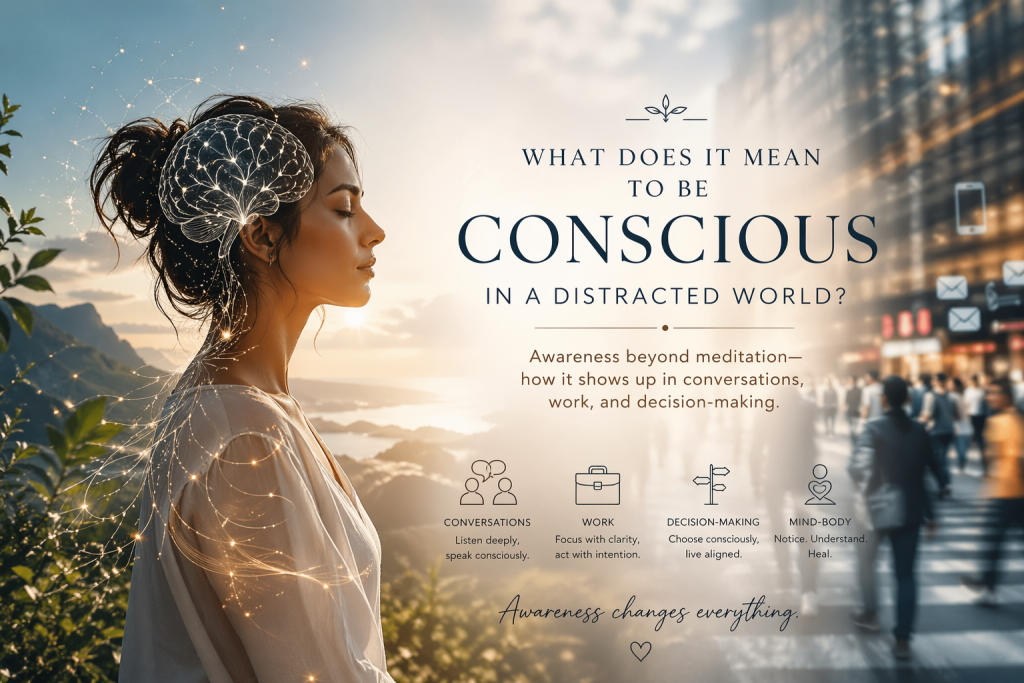
What Does It Mean to Be Conscious in a Distracted World?
We live in a time where attention is constantly being pulled outward notifications, conversations, expectations, responsibilities.
The modern world rewards speed, reaction, and productivity. But somewhere within all of this movement, something quieter often gets lost: awareness in the now.
To be conscious is not simply to be awake or informed. It is to be present within your own life while it is unfolding. It is the difference between reacting automatically and choosing deliberately. And in a distracted world, this distinction becomes everything.
Beyond Meditation: Consciousness in Real Life
Consciousness is often associated with stillness—meditation, silence, retreat. While these practices are powerful, they are only the beginning. True awareness is not something you visit for a few minutes a day; it is something you carry into every moment.
It shows up in the pause before you respond in a conversation.
In the way you notice tension in your body during a stressful meeting.
In the choice to step back instead of reacting impulsively.
Being conscious is not about removing yourself from life—it is about being deeply within it, without being consumed by it.
The Autopilot State
Most people move through their days on autopilot. Thoughts repeat, emotions react, habits take over. You may find yourself saying things you didn’t fully mean, feeling overwhelmed without understanding why, or ending the day unsure where your energy went.
This is not failure, it is conditioning.
The mind is designed to create patterns, to simplify, to predict. But when left unchecked, it begins to run your life rather than support it. Awareness interrupts this cycle. It creates a small but powerful space between stimulus and response.
And in that space, something shifts:
You begin to choose.
The Mind-Body Connection: Awareness as a Bridge
Your body is not separate from your mind it is a reflection of it.
Stress is not just a thought; it becomes tight shoulders, shallow breath, fatigue.
Unspoken emotions do not disappear; they settle into the body, often showing up as discomfort or imbalance.
When you become conscious, you begin to notice these signals earlier. A clenched jaw. A racing heart. A sense of unease you can’t quite explain.
Instead of ignoring them, you listen.
This is where healing begins not through force, but through awareness. The body speaks constantly. Consciousness allows you to hear it.
Consciousness in Conversations
One of the most powerful places to practice awareness is in how you relate to others.
In conversation, it is easy to listen only to respond. To defend, to prove, to be understood. But conscious communication asks something different it asks you to be present.
To notice your reactions as they arise.
To hear not just words, but tone and emotion.
To respond from clarity rather than impulse.
This does not make conversations perfect. It makes them real.
And over time, it transforms relationships—from reactive exchanges into meaningful connections.
Consciousness at Work
In professional spaces, distraction is often normalized. Multitasking, urgency, constant input it becomes the default way of operating.
But awareness changes the experience of work entirely.
It allows you to focus deeply rather than scatter your energy.
To make decisions with clarity instead of pressure.
To recognize when you are operating from stress versus intention.
Consciousness at work is not about doing less it is about doing things with presence. And presence often leads to better outcomes, not just more effort.
Decision-Making: From Reaction to Intention
Every day is shaped by small decisions. Most of them happen unconsciously.
You say yes when you mean no.
You avoid what feels uncomfortable.
You follow repeat patterns without questioning them.
Awareness brings these moments into the light.
When you are conscious, you begin to ask:
Why am I choosing this?
Is this aligned with how I want to live?
This is not about overthinking. It is about aligning your actions with your deeper sense of self.
The Emotional Layer of Awareness
Being conscious is not always comfortable.
It means feeling what you would normally avoid.
It means noticing patterns you may have outgrown.
It means sitting with emotions without immediately trying to fix or escape them.
But within this discomfort is something important: truth.
And within truth, there is freedom.
You begin to understand yourself not as a collection of reactions, but as an observer of them. And from that place, change becomes possible.
A Simple Practice for Daily Awareness
Consciousness does not require complexity. It begins with small, consistent moments of attention.
Try this:
Pause, even briefly, during your day.
Take a slow breath.
Notice what you are thinking.
Notice what you are feeling in your body.
No need to change anything. Just observe.
This simple act creates space. And in that space, awareness grows.
Living Consciously
To live consciously in a distracted world is not about perfection. You will still get caught in patterns. You will still react at times. That is part of being human.
But gradually, something shifts.
You return to yourself more quickly.
You respond with more clarity.
You begin to feel less pulled by external noise and more guided from within.
Consciousness is not a destination it is a practice. A quiet returning, again and again, to the present moment.
And in a world that is constantly asking for your attention, choosing awareness may be one of the most powerful things you can do.
It is where the mind softens.
Where the body speaks.